Research Reveals: COVID-19 mRNA Vaccines Could Revolutionize Cancer Therapy
A groundbreaking Nature study shows that COVID-19 mRNA vaccines may enhance cancer immunotherapy by unleashing powerful immune responses, turning resistant tumors into treatment-ready targets — a discovery that could transform oncology forever.

A New Frontier in Cancer Treatment
In a stunning breakthrough, scientists have discovered that COVID-19 mRNA vaccines may supercharge the effectiveness of cancer immunotherapies, transforming the way doctors might treat tumors in the future.
Published in Nature (October 2025), the study reveals that SARS-CoV-2 mRNA vaccines can amplify immune checkpoint inhibitor (ICI) therapy—a mainstay treatment for lung and skin cancers—by triggering a potent interferon-driven immune surge. This immune awakening effectively transforms “cold,” treatment-resistant tumors into “hot,” immunotherapy-responsive ones, offering new hope for patients who previously had limited options.
How the Study Unfolded
Researchers at The University of Texas MD Anderson Cancer Center analyzed real-world patient data alongside preclinical models and human immune studies. They found that patients with non-small cell lung cancer (NSCLC) and melanoma who received an mRNA COVID-19 vaccine within 100 days of starting ICI therapy had dramatically improved survival rates.
-
NSCLC patients: 3-year survival rate jumped to 55.7% in vaccinated individuals vs 30.8% in unvaccinated ones — a 49% reduction in mortality risk.
-
Melanoma patients: 3-year survival reached 67.6% in vaccinated vs 44.1% in unvaccinated groups.
Importantly, no similar benefit was seen with flu or pneumococcal vaccines, underscoring a unique mRNA-based immune mechanism.
The Science Behind the Synergy
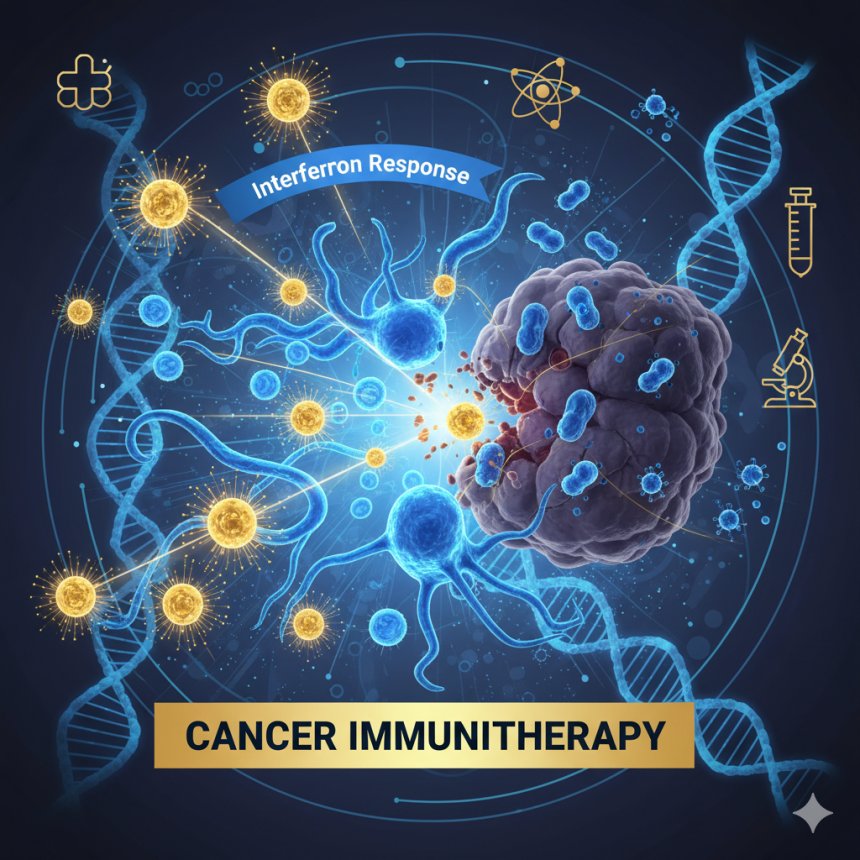
The team uncovered that mRNA vaccines spark an extraordinary type-I interferon (IFN) surge, a molecular signal that awakens the body’s dormant immune machinery.
Within 24 hours of vaccination, levels of interferon-alpha (IFN-α) surged by up to 280-fold, activating T-cells that recognize and attack tumors. This immune ignition caused previously invisible tumors to upregulate PD-L1, making them prime targets for checkpoint inhibitors.
In essence, the vaccine acts as a biological “booster switch,” teaching the immune system to see and destroy cancer cells. When the type-I interferon receptor (IFNAR1) was blocked in animal models, this synergy vanished — confirming the pathway’s crucial role.
Why This Could Revolutionize Healthcare
This discovery represents a paradigm shift in oncology and a major stride in repurposing existing vaccines for cancer treatment.
Traditionally, “cold” tumors — those invisible to the immune system — have resisted even the most advanced immunotherapies. Personalized mRNA cancer vaccines have shown promise but remain costly and time-consuming to develop.
However, COVID-19 mRNA vaccines are already globally available, safe, and scalable. If validated in future trials, this approach could offer an “off-the-shelf,” affordable way to make standard cancer immunotherapy more effective for millions.
“This is not just about COVID or cancer,” said lead author Dr. Andrew J. Grippin. “It’s about discovering how mRNA technology can be leveraged to reprogram the immune system against diseases once thought untouchable.”
What’s Next for Cancer Research
The study’s authors caution that the findings are observational and hypothesis-generating, calling for prospective clinical trials to confirm efficacy and safety. Yet, the implications are immense — suggesting that the same mRNA technology that helped the world fight a pandemic could now help humanity fight cancer.
As healthcare systems embrace mRNA-based platforms, this discovery could spark a new era of immune-driven medicine — one where vaccines and cancer therapies work hand-in-hand to turn the tide against even the most stubborn tumors.
Reference
Grippin, A. J., Marconi, C., Copling, S., Li, N., Braun, C., Woody, C., Young, E., Gupta, P., Wang, M., Wu, A., Jeong, S. D., Soni, D., Weidert, F., Xie, C., Goldenberg, E., Kim, A., Zhao, C., DeVries, A., Castillo, P., … Lin, S. H. (2025). SARS-CoV-2 mRNA vaccines sensitize tumours to immune checkpoint blockade. Nature. DOI: 10.1038/s41586-025-09655-y
Share