Breakthrough Cancer Therapy Halts Tumor Growth Without Harming Healthy Cells
Scientists at the Francis Crick Institute and Vividion Therapeutics have developed a new compound that blocks cancer’s growth signal without damaging healthy cells. The discovery, published in Science, marks a major advance in safer, targeted cancer treatments now entering human clinical trials.

A remarkable advancement in medical science is redefining how we fight cancer. Researchers from the Francis Crick Institute and Vividion Therapeutics have discovered a revolutionary cancer therapy that halts tumor growth without damaging healthy cells—a milestone that could reshape cancer treatment forever.
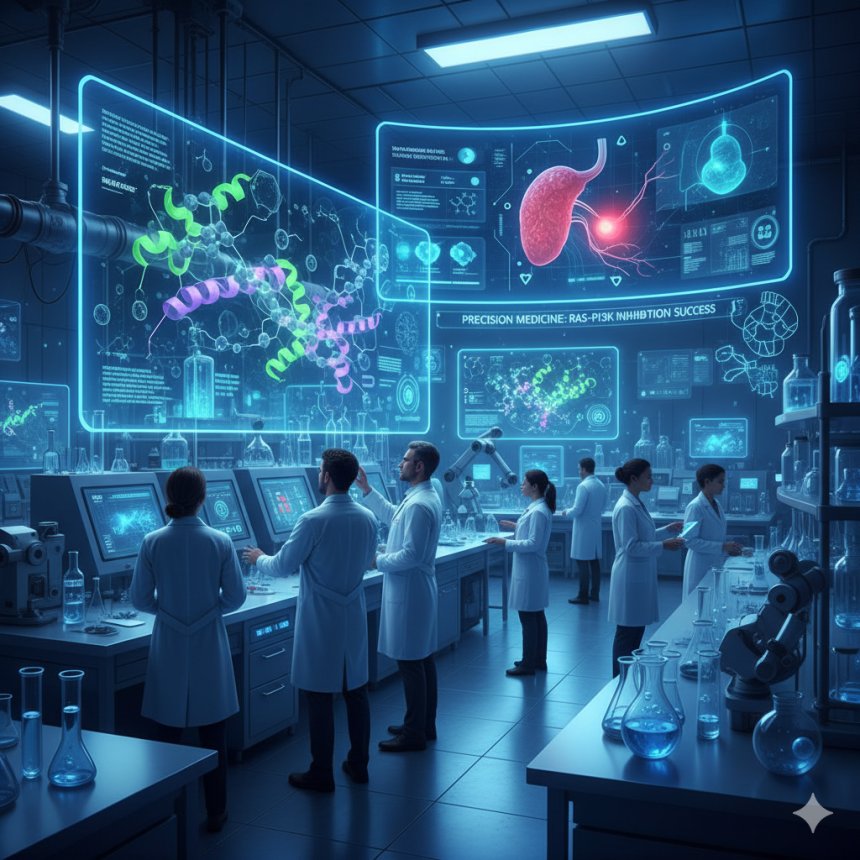
This cutting-edge study, published in Science on October 9, 2025, unveils a new compound that disrupts communication between the RAS gene and the PI3K enzyme, two critical drivers of tumor growth. The compound blocks this interaction so precisely that cancer cells stop growing, while healthy cells remain completely unaffected.
When tested in animal models—particularly in mice with lung and breast tumors—this therapy successfully stopped tumor progression without the side effects typical of older RAS-targeting drugs.
Understanding How the Therapy Works: Targeting Cancer’s “Go” Signal
The RAS gene is one of the most commonly mutated genes in human cancer, responsible for about 20% of all cancer cases. Under normal conditions, RAS acts like a cellular messenger, signaling cells when to grow and divide. But when mutated, it continuously sends “go” signals, causing cells to multiply uncontrollably—a fundamental characteristic of cancer.
Traditional cancer treatments that attempted to block RAS activity often failed because RAS is essential for many normal cellular functions. Completely silencing it disrupted healthy tissue, leading to severe side effects.
This new approach, however, is revolutionary. Instead of shutting down RAS or PI3K entirely, researchers found a way to block their interaction—a crucial handshake that sparks uncontrolled tumor growth. By stopping this connection, the therapy prevents cancer cells from receiving the “divide and grow” message without interrupting PI3K’s normal role in regulating metabolism and insulin signaling.
Even more importantly, this precision targeting prevents hyperglycemia, a common side effect of older PI3K inhibitors. It’s a surgical strike—one that selectively disables cancer’s communication channel while keeping healthy systems fully functional.
Preclinical Success: Promising Results in Animal Models
Through innovative chemical screening, scientists identified small molecules capable of attaching to the RAS-binding domain (RBD) of the PI3K enzyme. This permanent attachment blocks the enzyme’s ability to bind with RAS, essentially cutting off the tumor’s main communication line.
When tested in mice with RAS-mutated lung cancer, the therapy produced astonishing results. Tumor growth stopped completely, and the animals remained healthy throughout the treatment. Unlike traditional chemotherapy or targeted inhibitors, no toxic side effects were detected.
Researchers extended their tests to HER2-driven breast cancer models, another type of cancer that relies on similar signaling pathways. The outcome was just as remarkable—tumor progression came to a halt. This indicated that the therapy could have broad applications across multiple cancer types, not just those with RAS mutations.
Even more impressive were the results from combination therapies. When used alongside other enzyme inhibitors, the compound achieved stronger and longer-lasting tumor suppression, showing promise as part of a comprehensive cancer treatment plan.
This marks one of the few instances in modern cancer research where scientists have achieved total tumor growth inhibition without harming healthy tissue—an outcome that many considered impossible until now.
Entering Human Trials: A Step Toward Real-World Application
Following its success in preclinical studies, the compound has now advanced to Phase I human clinical trials. These early-stage trials will determine the therapy’s safety, optimal dosage, and preliminary effectiveness in patients with RAS and HER2 mutations—two notoriously difficult cancer types to treat.
If successful, this approach could revolutionize precision oncology, where treatments are designed to target each patient’s specific genetic mutations rather than using broad, one-size-fits-all chemotherapy methods.
Dr. Julian Downward, Principal Group Leader at the Francis Crick Institute, described the finding as a game-changer:
“We’ve overcome one of cancer biology’s biggest challenges—blocking RAS signaling without harming normal cells.”
Similarly, Matt Patricelli, Chief Scientific Officer at Vividion Therapeutics, highlighted the innovation’s elegance:
“By focusing on the interaction point rather than disabling the entire enzyme, we’ve opened the door to safer, more effective cancer therapies.”
This targeted strategy could dramatically reduce side effects, making cancer treatment more tolerable while maintaining—or even improving—its effectiveness.
Scientific Study Reference
Citation:
Klebba, J.E., Roy, N., Bernard, S.M., et al. (2025). Covalent inhibitors of the PI3Kα RAS binding domain impair tumor growth driven by RAS and HER2. Science. DOI: 10.1126/science.adv2684
Study Overview:
| Parameter | Details |
|---|---|
| Study Type | Preclinical (mice) |
| Mechanism | Blocks RAS-PI3K interaction |
| Cancer Types Tested | Lung (RAS-mutated), Breast (HER2-driven) |
| Key Findings | Tumor growth halted completely |
| Side Effects | None observed (no hyperglycemia) |
| Next Step | Phase I human trials |
| Potential Impact | Broad-spectrum cancer therapy with minimal toxicity |
Why This Discovery Matters
Cancer research has long been dominated by two opposing challenges: how to stop tumor growth effectively and how to protect healthy cells. Traditional treatments like chemotherapy and radiation often succeed in destroying cancer cells but come at the cost of severe damage to healthy tissue.
This new RAS-PI3K blocking strategy offers the best of both worlds—a way to neutralize cancer’s growth mechanism without disrupting essential biological functions. It’s a precision therapy that represents a major leap forward in molecular medicine.
Moreover, its mechanism could have implications beyond cancer. By controlling signaling pathways so precisely, researchers may be able to adapt this approach to treat other diseases driven by protein miscommunication, such as autoimmune and inflammatory disorders.
If the ongoing clinical trials confirm its safety and efficacy, this could become a foundational treatment in oncology, reshaping cancer therapy worldwide.
A New Era for Cancer Treatment
This discovery doesn’t just add another drug to the oncology arsenal—it introduces a new therapeutic philosophy. Instead of aggressively attacking cancer with toxic chemicals, scientists are now learning to disrupt cancer’s communication networks.
It’s like cutting off the power supply to a rogue machine: the tumor can no longer function, yet the surrounding environment remains untouched. This level of precision could usher in a new era of cancer treatment that is both powerful and humane.
With continued success in human trials, patients may soon have access to a treatment that stops tumor growth safely, effectively, and without the debilitating side effects that have long been the price of survival.
Conclusion
The collaboration between the Francis Crick Institute and Vividion Therapeutics has achieved what decades of research struggled to deliver: a targeted cancer therapy that halts tumor growth without harming healthy cells. By blocking the RAS-PI3K interaction, scientists have discovered a safer, more precise way to tackle even the most aggressive cancers.
As this therapy enters clinical trials, the medical world watches with anticipation. It represents not just progress in cancer research but a glimpse into the future of personalized medicine—where every treatment is as unique as the patient it serves.
If successful, this innovation could redefine how humanity fights cancer, transforming fear into hope and turning one of medicine’s greatest challenges into one of its greatest triumphs.
Share