GE HealthCare & Erasmus MC Partner: Revolutionizing Precision Cancer Care with Total Body PET/CT
Explore GE HealthCare's partnership with Erasmus MC to advance cancer diagnostics. Learn how next-gen total body PET/CT & AI aim to transform early detection, treatment planning, & theranostics.

A Small Request to Our Valued ReaderWe hope this deep dive into the future of cancer care has been insightful and empowering. Our mission is to cut through the noise and provide you with comprehensive, well-researched content that truly adds value. This level of analysis requires significant time and effort. If this article helped you understand this exciting medical advancement, we would be incredibly grateful if you could:
|
A New Dawn in the Fight Against Cancer: How GE HealthCare and Erasmus MC Are Forging the Future of Precision Oncology
In the relentless battle against cancer, the difference between hope and despair often hinges on a single, critical factor: clarity. For clinicians and patients navigating the complex labyrinth of diagnosis and treatment, the ability to see the enemy clearly—its location, its strength, its very molecular nature—is the cornerstone of victory. It is at this pivotal intersection of medical need and technological innovation that a landmark collaboration is taking shape, one poised to redefine the boundaries of what’s possible in cancer care.
GE HealthCare Technologies Inc. (GEHC), a global leader in medical technology, pharmaceutical diagnostics, and digital solutions, has announced a strategic partnership with the Erasmus MC University Medical Center, a world-renowned research institution in the Netherlands. Their shared mission is to evaluate and refine a groundbreaking piece of technology: GE HealthCare’s next-generation total body Positron Emission Tomography and Computed Tomography (PET/CT) scanner. This isn't merely an incremental upgrade; it represents a potential paradigm shift in precision imaging, with profound implications for early disease detection, personalized treatment planning, and the emerging field of theranostics.
This article delves deep into this partnership, unpacking the science behind the technology, the market forces at play, the potential impact on patient outcomes, and what it signals for the future of oncology and medical imaging as a whole.
The Partnership Unveiled: A Meeting of Minds and Missions
At its core, the collaboration between GE HealthCare and Erasmus MC is a symbiotic union of industrial innovation and clinical excellence.
GE HealthCare: A Legacy of Imaging Innovation
Spun off from General Electric in early 2023, GE HealthCare carries forward a storied 125-year legacy in healthcare technology. The company is a powerhouse in the medical imaging market, with leading positions in MRI, CT, ultrasound, and crucially, molecular imaging through its PET/CT and SPECT/CT systems. For GEHC, this partnership is a strategic move to solidify its leadership by validating its most advanced technology in a real-world, high-stakes clinical research environment. It’s about moving from theoretical potential to proven clinical utility.
Erasmus MC: A Crucible of Clinical Research and Theranostics
Erasmus MC is not just any academic hospital; it is a pioneer, particularly in the field of theranostics—a portmanteau of "therapy" and "diagnostics." This revolutionary approach involves using radioactive compounds for both diagnosing and treating diseases, primarily cancer. Erasmus MC has been at the forefront of developing and implementing treatments like Lu-177-Dotatate for neuroendocrine tumors. Their clinicians and researchers possess the deep expertise necessary to push imaging technology to its limits, asking the complex questions that can lead to genuine breakthroughs.
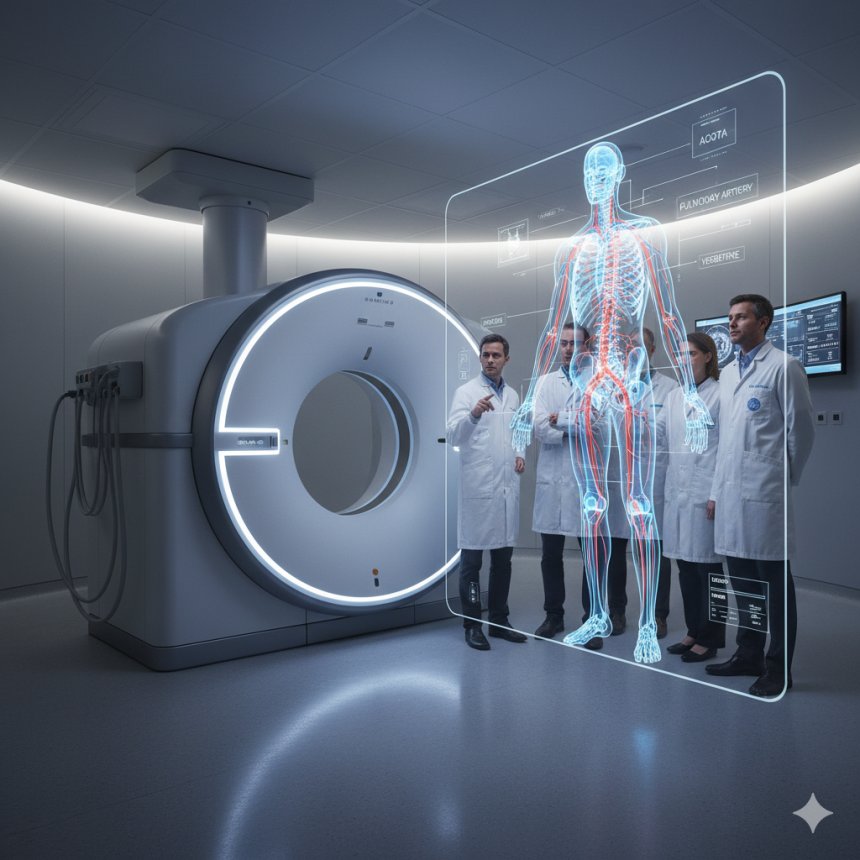
Together, they will focus on GE HealthCare’s crown jewel in molecular imaging: a total body PET/CT scanner with a revolutionary 128 cm axial field of view.
Deconstructing the Technological Leap: What is Total Body PET/CT?
To appreciate why this collaboration is so significant, one must first understand the limitations of conventional PET/CT systems and the transformative potential of this new technology.
The Limitations of Conventional PET/CT
A standard PET/CT scanner has an axial field of view (the coverage along the length of the body) of approximately 15-30 cm. To image an entire patient, the scanner bed moves the patient through the machine in a series of sequential steps, or "bed positions." This process has several drawbacks:
-
Long Acquisition Times: A full-body scan can take 20-30 minutes, which is challenging for patients, especially those who are ill or in pain.
-
Limited Temporal Resolution: Because the scan is pieced together, it's difficult to capture dynamic processes, like how a tracer flows through the bloodstream and distributes itself in tissues, simultaneously across multiple organs.
-
Higher Radiation Dose: To achieve clear images, a sufficient amount of radioactive tracer must be injected. While safe, the principle of ALARA (As Low As Reasonably Achievable) always guides practice, mandating minimal radiation exposure.
-
Incomplete Data for Dynamic Studies: Traditional systems struggle to provide a comprehensive, system-wide view of kinetic processes in real-time.
The Revolution of a 128 cm Axial Field of View
GE HealthCare's next-generation system shatters these constraints. With an axial field of view of 128 cm, it can capture images of the entire body—from head to thighs, or even toes—simultaneously. This fundamental shift in design unlocks a host of clinical advantages, which the Erasmus MC collaboration aims to quantify:
-
Ultra-Low Dose Imaging: By capturing more of the emitted signal simultaneously, the system is exponentially more sensitive. Early research on similar total-body PET concepts, such as the EXPLORER scanner developed at UC Davis, has suggested a potential for up to 40-fold increase in sensitivity (Reference: Cherry, S. R., et al. (2018). Journal of Nuclear Medicine). This could allow for radical reductions in the required radiotracer dose, making scans safer for pediatric patients, those requiring frequent monitoring, and participants in clinical trials.
-
Faster Image Acquisition: What took 20 minutes could potentially be completed in under two. This dramatically improves patient comfort and increases scanner throughput, a key economic driver for hospitals facing backlogs.
-
Multi-Organ Dynamic Imaging: This is perhaps the most scientifically exciting aspect. For the first time, clinicians can observe a radiotracer as it enters the bloodstream and perfuses through every organ in the body at once. As stated by Dr. John Boone, a leading researcher in radiology at UC Davis, this allows for "whole-body pharmacokinetics." This means we can study not just where a cancer is, but how it interacts with the entire body's systems in real-time, and similarly, how a drug distributes and acts upon the entire body.
-
Enhanced Diagnostic Accuracy: The combination of ultra-high sensitivity and total-body coverage can reveal minuscule lesions that were previously undetectable, leading to more accurate staging of cancer. This can fundamentally change a patient's treatment pathway.
The Clinical Impact: From Pixels to Patients
The evaluation at Erasmus MC will translate these technical specifications into tangible patient benefits across the cancer care continuum.
1. Supercharging Early Detection and Diagnosis
The ability to detect smaller cancerous lesions with higher confidence could lead to earlier stage-at-diagnosis for many cancers. Catching cancer early is the single most important factor in improving survival rates. A more sensitive PET/CT could become a powerful tool for screening high-risk populations.
2. Re-defining Personalized Treatment Planning
In the era of precision oncology, one size does not fit all. Total body PET/CT, with its dynamic imaging capabilities, can provide a "molecular fingerprint" of a tumor. By understanding the unique biological behavior of a patient's cancer, oncologists can make more informed decisions about which therapy—be it chemotherapy, immunotherapy, or a targeted radioligand therapy—is most likely to be effective.
3. Unlocking the Full Potential of Theranostics
Erasmus MC's expertise makes this area particularly pivotal. Theranostics is a two-step process: first, a diagnostic radiotracer is used to locate cancer cells that express a specific target (e.g., PSMA for prostate cancer). Then, a therapeutic radiotracer targeting the same molecule is delivered to destroy those cells.
Total body PET/CT can revolutionize both steps:
-
Diagnostic Precision: It can identify more, and smaller, metastases with exquisite clarity, ensuring patients are correctly selected for therapy.
-
Treatment Verification and Dosimetry: After therapy, the same scanner can be used to precisely measure how much radiation is delivered to the tumors and, critically, to healthy organs. This allows for real-time dose adjustment, maximizing tumor kill while minimizing side effects—the very definition of personalized medicine.
4. Accelerating Drug Development
The pharmaceutical industry can leverage this technology to accelerate clinical trials. By providing a comprehensive, quantitative view of how an investigational drug distributes and engages with its target throughout the entire body, total body PET/CT can provide earlier and more reliable go/no-go decisions, potentially bringing life-saving drugs to market faster.
The Role of Artificial Intelligence: The Intelligent Engine
It's important to note that this technological leap is not solely hardware-based. GE HealthCare is deeply integrating Deep Learning-based AI algorithms into the platform. AI plays a crucial role in:
-
Enhancing Image Quality: AI can denoise images, allowing for further dose reduction or faster scan times without compromising diagnostic clarity.
-
Automating Workflows: From patient positioning to organ segmentation and lesion quantification, AI can automate tedious tasks, boosting operational efficiency and reducing technologist burnout.
-
Extracting Quantitative Biomarkers: AI can help analyze the vast, complex datasets generated by a dynamic total body scan, extracting precise quantitative measurements that are beyond human perception.
Market Context and Financial Implications
This partnership is occurring against a backdrop of robust growth in the cancer diagnostics market.
A Booming Market
According to a report by Grand View Research, the global cancer diagnostics market was valued at $109.61 billion in 2024 and is projected to expand at a compound annual growth rate (CAGR) of 6.14% to reach $155.07 billion by 2030. This growth is fueled by the rising global cancer burden, continuous technological advancements, and increasing awareness and investment from both public and private entities.
Strategic Positioning for GE HealthCare
For GEHC, success in this collaboration with Erasmus MC is a key to capturing a larger share of this expanding market. A validated, best-in-class total body PET/CT system would be a formidable competitive asset. It would drive long-term revenue growth through:
-
High-Margin System Sales: These advanced systems command premium prices.
-
Recurring Revenue Streams: Sales of associated software, AI applications, contrast agents, radiopharmaceuticals, and service contracts create a stable, recurring revenue base.
-
Brand Leadership: Being at the forefront of a technological revolution enhances the entire GE HealthCare brand, creating a halo effect for its other product lines.
A Note on GEHC Stock (for informational purposes only, not financial advice)
Following the announcement, GEHC shares showed little immediate movement, and they are down 5.1% year-to-date, underperforming against the broader S&P 500. This is not uncommon for long-term R&D partnerships where financial payoffs are years away. The market often struggles to value future potential against current earnings.
However, with a market capitalization of $34.3 billion and an earnings yield of 6.03% (significantly higher than its industry peer group), GEHC presents a profile of a company with solid fundamentals investing heavily in its future. This partnership is a concrete example of that investment. If the technology is successfully validated and adopted, it could become a significant growth driver, potentially improving investor sentiment over the medium to long term by strengthening GEHC's moat in the high-growth molecular imaging segment.
The Road Ahead: Challenges and Opportunities
The path from research collaboration to widespread clinical adoption is not without its hurdles.
-
Cost: The development and manufacturing of such complex systems are incredibly expensive, which will be reflected in the purchase price, potentially limiting initial adoption to major academic and research centers.
-
Reimbursement: Healthcare systems and insurers will need to be convinced of the cost-effectiveness of this technology, requiring robust health-economic data demonstrating improved patient outcomes and system-wide savings.
-
Data Management: The volume and complexity of data generated by each scan are immense, necessitating advanced IT infrastructure and new analytical tools.
Despite these challenges, the opportunities are monumental. This partnership is more than a corporate press release; it is a beacon of progress. It represents a shared belief that through a combination of visionary engineering, world-class clinical science, and artificial intelligence, we can fundamentally alter the trajectory of cancer care, moving from a one-size-fits-all approach to a future where every treatment plan is as unique as the patient itself.
Conclusion: A Vision of the Future, Being Built Today
The strategic collaboration between GE HealthCare and Erasmus MC is a testament to the power of partnership in driving medical progress. By focusing on the transformative potential of total body PET/CT, they are not just testing a new machine; they are laying the groundwork for a new standard of care in oncology. This technology promises a future where cancer is detected with unparalleled earliness, characterized with molecular precision, and treated with personalized therapies, all while minimizing the burden on the patient.
It is a future where the image of cancer is no longer a blurry, fragmented puzzle, but a clear, comprehensive, and dynamic map—a map that guides clinicians and patients, step by step, toward a cure.
Share